
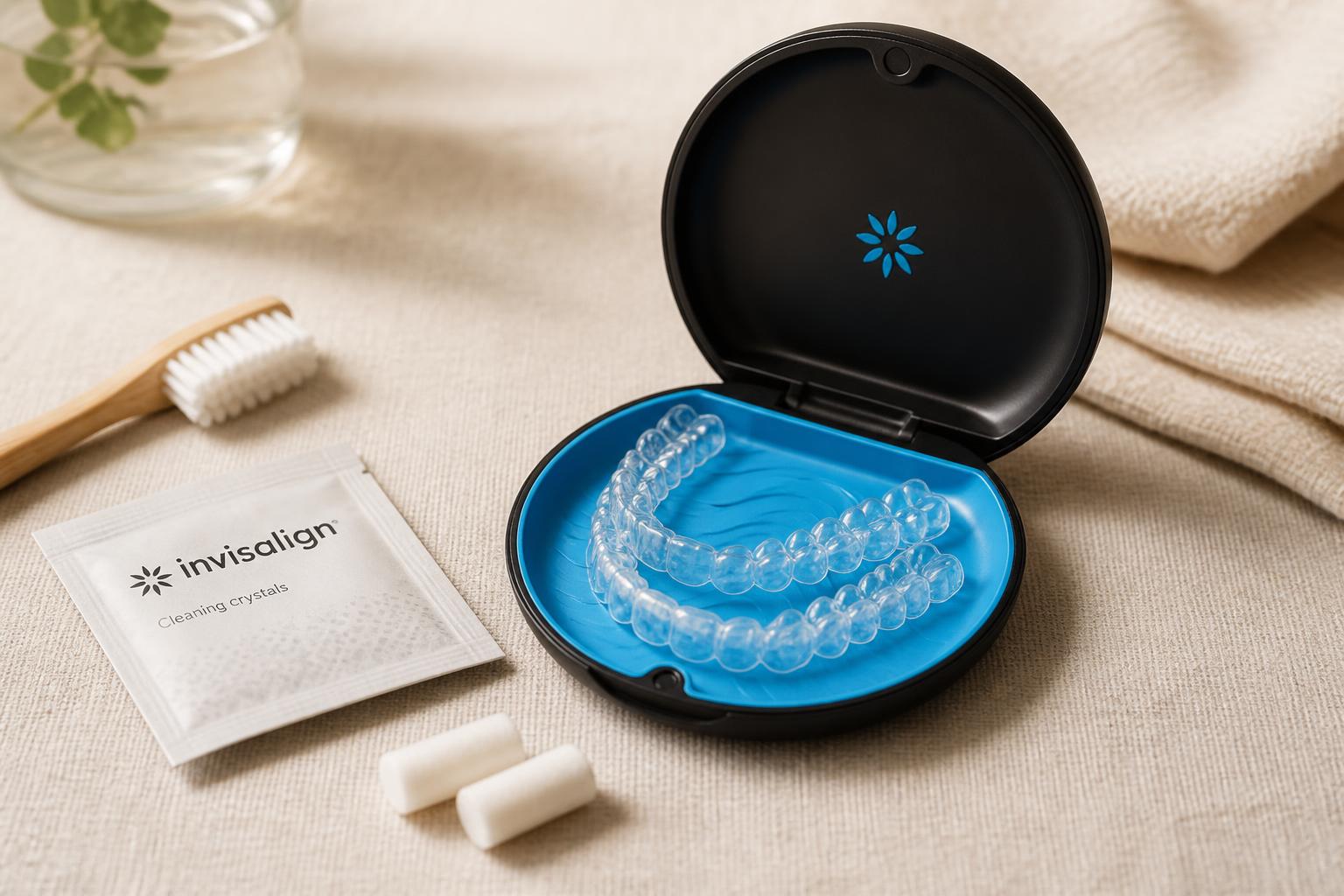
Daily wear
- Aim for 22 to 23 hours a day. Wear time governs the result and the length of treatment more than any other factor.
- Remove to eat and to drink anything other than plain cold water. Hot drinks distort the plastic and coloured drinks stain it.
- Clean your teeth before the aligners go back in. Sugar or acid trapped under an aligner sits against the enamel for hours.
- Change to the next set on the schedule you were given, in the evening, so the tightest hours pass while you sleep.
Seating the aligners
- Seat the front teeth first, then press evenly over the back teeth on both sides.
- Bite on the chewies for two minutes after every insertion, working around the whole arch. This closes the small gaps between the aligner and the tooth that otherwise stall the movement.
- Remove from the back teeth first, working forward, so the attachments are not stressed.
Cleaning the aligners
- Rinse in cool water each time they come out, and brush gently with a soft brush and unperfumed soap.
- Never use hot water, boiling water, or a dishwasher. Heat distorts the plastic and a distorted aligner no longer fits.
- Do not use toothpaste on the aligners. It is abrasive and leaves the surface cloudy.
- Store them in the case whenever they are out. Aligners wrapped in a napkin get thrown away.
Attachments and IPR
The small tooth-coloured bumps bonded to some teeth are attachments. They give the aligner something to push against, and each one is placed for a specific movement in the plan. If one comes off, contact the practice so it can be replaced.
Where space is created between teeth by interproximal reduction, a very fine amount of enamel is polished from the contact points. It does not weaken the teeth and it does not cause sensitivity.
What to expect
- Tightness and aching for the first day or two after each change is normal and settles.
- A slight lisp for the first few days is common and resolves as the tongue adapts.
- A rough edge can usually be smoothed. Ask before filing it yourself.
- If an aligner is lost, return to the previous set and contact the practice. Do not skip forward.
After treatment
Teeth move throughout life. Retention is not an optional extra at the end of orthodontic treatment; it is the part that determines whether the result holds. Expect to wear retainers indefinitely, on the schedule you are given.
General guidance from Dr Vikas Prinja, GDC No. 265374. It does not replace the specific instructions given for your own treatment.